
If you sell or grow with peat-based substrates, your own customers are probably asking whether peat is sustainable. A vague answer can weaken trust, and an overstated one can damage your credibility. This article explains what “slowly renewable” means, how peat extraction is regulated in Latvia, how bogs are restored after harvesting, and what to ask your supplier.
Short answer: Peat moss is a slowly renewable resource. It forms over centuries, so it does not renew on a human timescale the way coir or wood fibre do. It can be used responsibly when extraction is limited and licensed, and when harvested sites are actively restored so that sphagnum moss grows and peat starts forming again.
What Does “Slowly Renewable” Mean for Peat Moss?
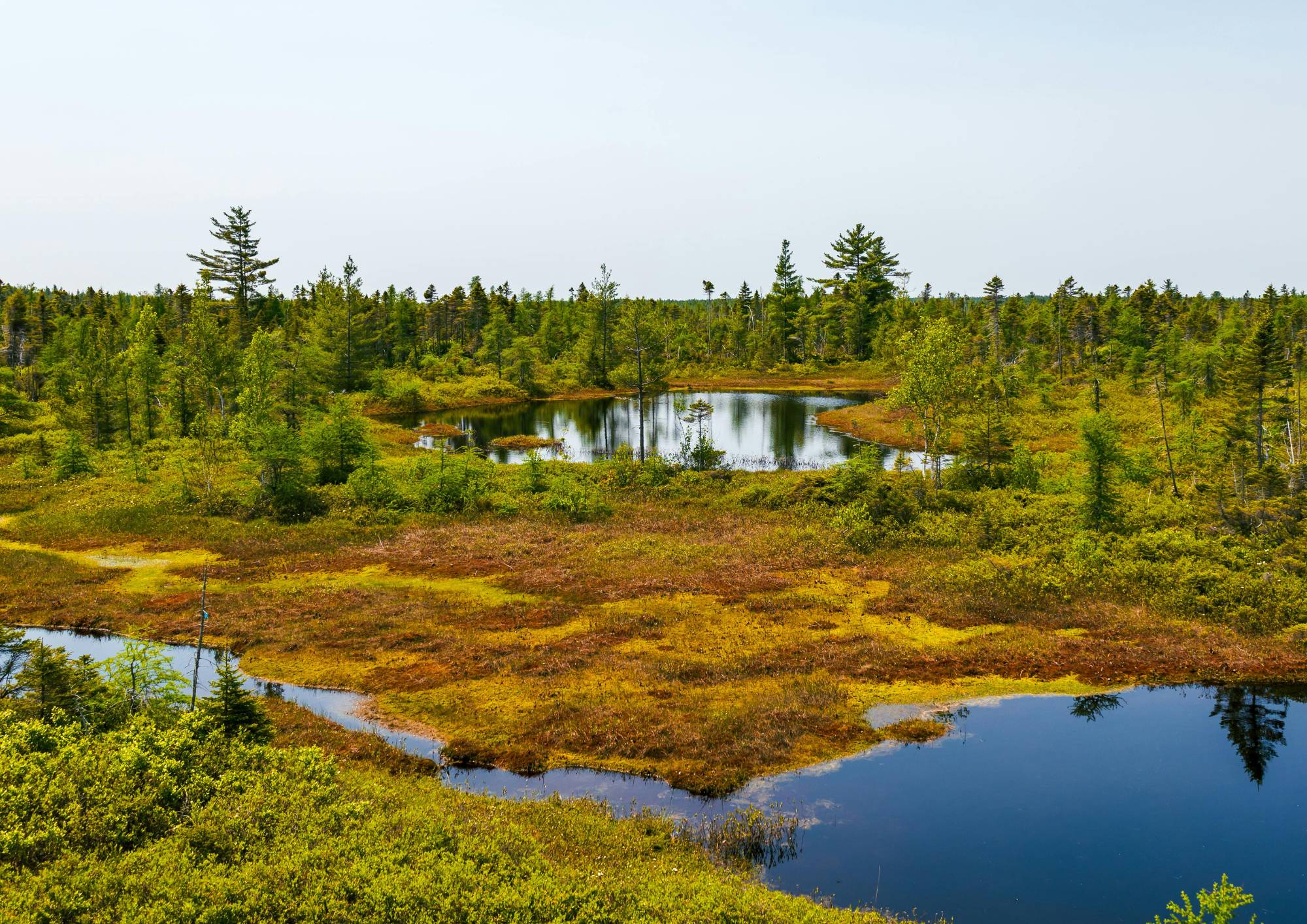
Peat forms in waterlogged bogs. There is little oxygen in the water, so sphagnum moss and other plants decompose only partly and build up layer by layer. This process is slow. Rates of about 1 mm per year are commonly cited for raised bogs, and the Latvian Peat Association uses an average of 2 mm per year for Latvia. At these rates, one metre of peat takes roughly 500–1,000 years to form.
This is why “slowly renewable” is more accurate than simply “renewable.” Whether peat use is responsible depends on two things: how much is extracted compared with the total peatland resource, and what happens to a site after harvesting ends.
Latvia has a large resource base. Bogs cover about 10% of the country’s territory and hold around 1.7 billion tonnes of peat. Based on the 2 mm rate, the Latvian Peat Association estimates that about 1.6 million tonnes of new peat accumulate each year, while extraction in 2021 was about 1.25 million tonnes. To learn how these bogs formed and how their use has changed over time, read our article on the history and significance of Latvia’s peat bogs.
These figures are the industry’s own estimate. They do not mean that peat use is climate-neutral. A drained, harvested site releases carbon dioxide (CO₂) as the exposed peat oxidises, and new growth in intact bogs elsewhere does not cancel those emissions. That is why the restoration of harvested sites matters as much as the size of the resource.
How Is Peat Extraction Regulated in Latvia?
Peat extraction in Latvia requires a licence. Before work starts, the operator must assess the deposit and its environmental impact and plan how the site will be used after extraction ends. Sites often stay in operation for decades, so this after-use plan is part of the project from the beginning, not an afterthought.
According to the Latvian Peat Association (data as of 1 January 2026):
- Extraction takes place on about 4% of Latvia’s peat deposit territory.
- 126 licences are in force across 99 bogs, held by 57 companies and one private individual.
- The total licensed area is about 25,880 hectares.
For a buyer, regulation gives you something practical: a traceable origin. Peat from a licensed Latvian site comes from a defined area, with a documented extraction and after-use plan.
How Do Bogs Regenerate After Peat Harvesting?
A harvested bog does not recover quickly on its own. Drainage ditches keep the water table low, so the remaining peat continues to dry and oxidise, and the site is often colonised by birch or pine rather than bog vegetation. Active restoration reverses this. It usually follows three steps:
- Rewetting. Drainage ditches are blocked so the water table rises close to the surface again. This stops most of the peat oxidation.
- Reintroducing sphagnum moss. Fragments of native sphagnum are spread on the bare peat, often covered with straw mulch to protect them while they establish.
- Monitoring. Water levels, vegetation cover and, on research sites, greenhouse gas emissions are measured to confirm that the restoration is working.
A sphagnum cover can establish within several years, but a fully functioning, peat-forming bog takes decades. Restoration is not the only after-use option. Former extraction sites in Latvia are also converted to forest, water bodies or berry plantations such as cranberries and blueberries, depending on the site conditions and the approved plan.
The climate case for rewetting is well supported. According to a Bankwatch analysis of Latvia’s peat sector, restoring the water regime significantly reduces CO₂ emissions from former extraction sites and can turn them into carbon sinks with sequestration potential equal to, or greater than, intact bogs. The same source notes that about 26,232 hectares of historical extraction sites in Latvia still require remediation. Much of this legacy dates from earlier decades, before current planning rules applied.
Why Does Peat Still Have a Place in Professional Growing?
Coir, wood fibre and composted bark are now widely used, and in many blends they perform well. Peat remains a core component in professional substrates because it combines several properties in one material:
Water-holding capacity.
Peat holds several times its own weight in water, which supports even moisture between irrigation cycles.
Air-filled porosity
Its fibrous structure keeps air around the roots, especially in coarser fractions (particle-size ranges, such as 10–30 mm).
Low, adjustable pH
Natural sphagnum peat is acidic, which suits blueberries and other acid-loving crops. For most other crops, growers add lime to raise the pH.
Low weed and pathogen load
Peat is not sterile, but it is naturally low in weed seeds and soil-borne pathogens, which matters in propagation.
Batch consistency
Properly graded peat behaves predictably, so irrigation and fertilisation programmes give repeatable results.
The responsible approach is not to avoid peat entirely, but to use it where it adds clear value and to replace part of it where an alternative performs equally well.
How We Approach Responsible Peat Use at ETEPEK
We work with planned extraction sites and keep untouched buffer zones around sensitive areas. After harvesting, sites are rehabilitated by managing water levels and reintroducing native plants so that sphagnum moss can grow again.
We also work with alternative materials, including wood fibre and composted bark, to reduce the peat share where these materials suit the crop. A custom peat moss blend helps here: matching fraction, pH and additives to your crop avoids over-specifying and wasting raw material. You can read more about our practices on our sustainability page.
Learn more about our practices on our Sustainability page
What Should You Ask Your Peat Supplier About Sustainability?
If sustainability matters to your customers, ask for answers you can pass on. Useful questions include:
- Which country and region does the peat come from, and is the extraction site licensed?
- What is the after-use plan for the site: restoration, forestry, water body or agriculture?
- Are buffer zones kept around sensitive areas?
- Can the supplier offer blends with a reduced peat share, using coir, wood fibre or bark?
- Can the supplier provide documentation of origin for your own customers or certifiers?
A supplier who answers these clearly gives you a stronger position with your own buyers than one who relies on general claims.
Key Takeaways
- Peat moss is slowly renewable. It accumulates at around 1–2 mm per year, so extraction must be limited and planned.
- In Latvia, extraction is licensed and takes place on about 4% of the peat deposit territory.
- Harvested bogs need active restoration. Rewetting and sphagnum reintroduction cut CO₂ emissions and restart peat formation.
- Peat remains valuable for its water-holding capacity, aeration, adjustable pH and batch consistency.
- Partial replacement with coir, wood fibre or bark reduces peat use where crops allow.
- Ask your supplier about site licensing, after-use plans and documentation of origin.
Learn more about our sustainability practices, or explore our peat moss substrates and request a quote for your next order.
You might also like

How Peat Moss Helps Clean Water
Discover how natural peat moss is used as an eco-friendly filter to remove pollutants and purify water in both industrial and home settings
Read the article
Latvia Peat Bogs: History, Peat Moss Use and Sustainability
Latvia Peat Bogs: History, Peat Moss Use and Sustainability
Read the article
Another Sunny Day in Poultry Farm: Cozy Chick’s Diary
Discover Why Peat Moss is the Ultimate Eco-Friendly Bedding Choice for Poultry!
Read the article